
I am right in the middle of it
You’re likely familiar with the experience: someone on stage tells a compelling story, or actors perform a scene. When you become completely immersed, it feels as though you are right there in the middle of the situation. Video can significantly enhance this experience by serving as an interactive element of the set. No matter where the story leads, these video backdrops allow you to move seamlessly along with the narrative—as if you were right in the heart of it.
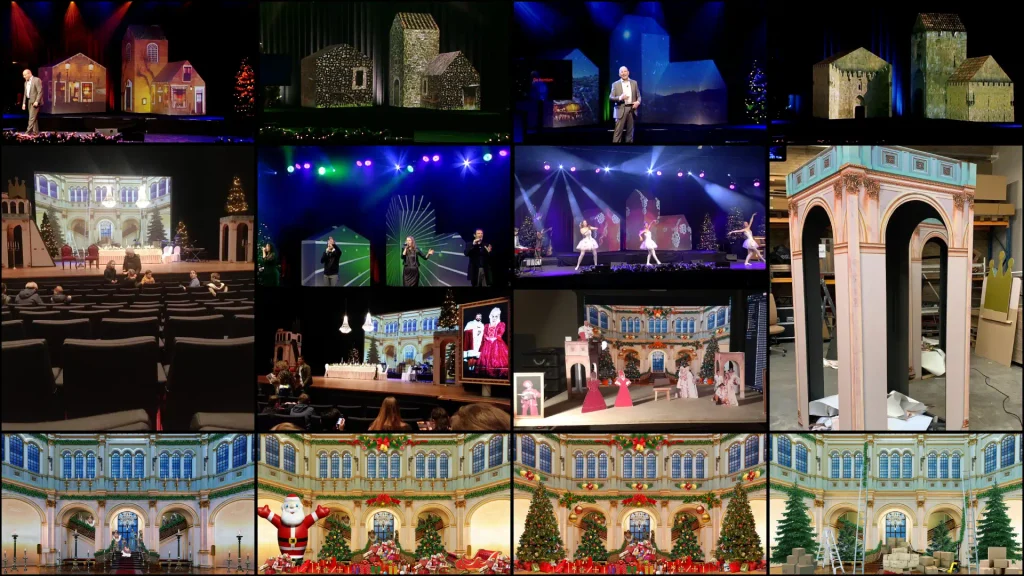
The play ‘The King on His Throne’ was set in a palace. We didn’t have many resources to create an elaborate palace environment—just a beautifully set table and two chandeliers—but we did have a large projection screen at the back. I sourced an image of a suitable palace and adjusted it so that the perspective in the background enhanced the sense of depth on stage. Because it was a projection, I could incorporate various elements into the palace setting to align with the narrative. For instance, at the beginning, we see boxes, ladders, and bare Christmas trees, as the palace prepares for the Christmas dinner. Later, when the story touches upon Christmas gifts, the floor becomes strewn with presents; at another point, when Santa Claus is mentioned, a large inflatable Santa appears within the palace. There is also dynamic lighting within the palace scene, synchronized with the live band playing Christmas carols. As the story eventually reveals the true meaning of Christmas, the palace transforms into an intimate, cozy setting, centered around a nativity scene. I was also able to extract specific textures from this digital backdrop and apply them to two large objects on stage, ensuring they matched the wall patterns of the palace in the background. In this way, video is utilized as an interactive component of the production’s overall set design.
A technician from the Bethel church had access to software for 3D projection mapping and asked if I could use it for the Christmas services. I tested the software (Resolume Arena) in my kitchen at home and thought it would be a great challenge to create something interesting with it. The idea was to place two simple, white-painted wooden houses on the stage, which we could transform using projections to reflect the narrative the pastor was sharing—covering figures like Mary, Herod, the Magi, and the shepherds. Since we were already incorporating clips from the film ‘The Nativity Story,’ I decided to create matching textures so that the houses would shift to resemble structures featured in the movie. The opening sequence had been filmed in the town of Sloten, so I took photographs of the historic houses there and projected those images onto our stage structures. In this way, the video projections and the physical set pieces on stage blended into a cohesive whole. It was wonderful to see people coming up after the service, curious about how these houses could so mysteriously transform along with the unfolding story—a story that is, in itself, truly full of wonder.
The music moves
Music functions in much the same way as video backdrops: it enhances the atmosphere of the story you are watching. The magnificent soundtracks accompanying films are a prime example of this. Video and music can reinforce one another even further when they move in the same rhythm—think of visuals accompanying a dance performance, or an African savanna that truly comes to life when the music shifts to an entirely different mood.
Things get more complicated with live music performances. The song must be locked into a clicktrack within the video beforehand, which the live band can then follow. Alternatively—as was the case for the teen event ‘Square’—the video must be able to move in real-time, synchronized with the music.
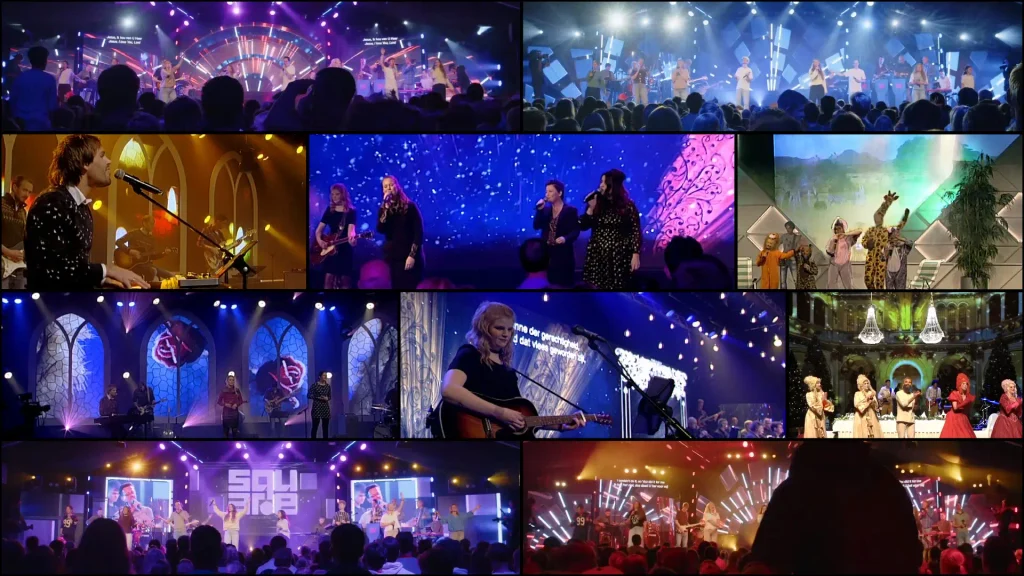
For the teen event ‘Square,’ I developed an interactive digital stage design for the LED screens positioned behind the stage. Using Cinema 4D, I created a set design featuring surfaces for video projection, as well as shapes incorporating fluorescent-style light bars to add visual accents. To ensure the visuals could move in sync with the music, I prepared a variety of ‘slow,’ ‘medium,’ and ‘fast’ video loops that could be triggered on demand. I also created short, one-off accent clips designed to illuminate the light bars in time with specific musical beats. By building a robust content library and an intuitive control system for triggering and color-adjusting these elements, I was able to make the video backdrop react dynamically to the band’s performance. I implemented this setup using Pro Video Player, controlled via custom-configured buttons on a Stream Deck. Although this software isn’t strictly designed for this purpose, I opted for it due to its cost-effectiveness and flexibility; by integrating it with Companion, I was able to create a highly functional and effective solution.
I don’t know where to look
The experience becomes even more powerful when you work not with a single screen, but with multiple screens that combine to form one large, cohesive whole—acting as part of a grand set design to enhance the narrative from a variety of perspectives. Performers can interact with the screens—engaging in conversation with a character who appears within a painting, ducking to avoid stones flying through the space, or becoming completely immersed in a game that unfolds all around them. This taps into our human capacity for imagination: the ability to lose ourselves in a fictional world where anything can happen. You step inside, and you hardly know where to look first.
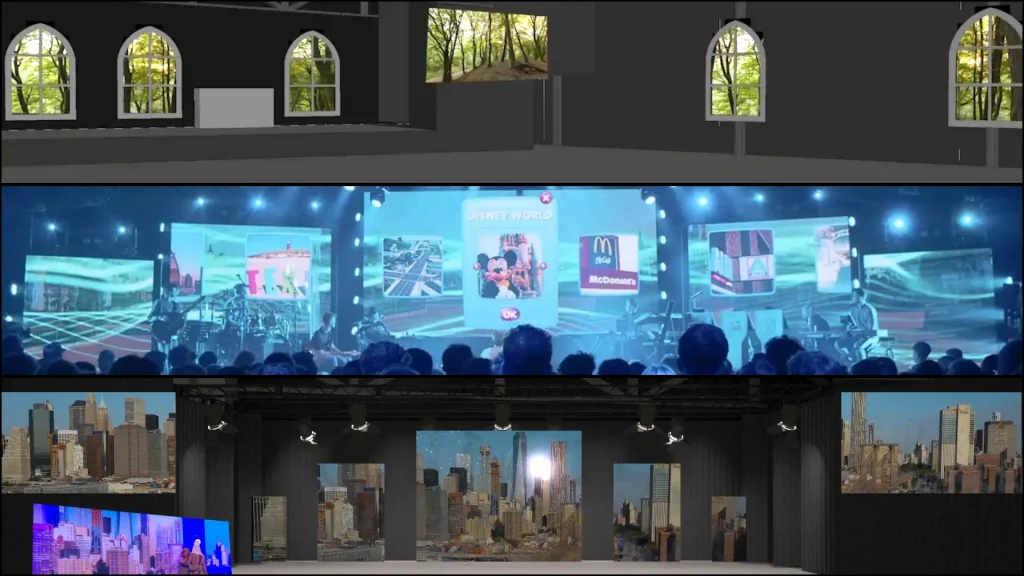
For the teen event “Square,” the decision was made to incorporate multiple LED screens on stage, allowing video content to blend seamlessly into the overall production. The theme that year was “This is living,” with the game console serving as an iconic centerpiece—a representation of the world in which we live and move. This inspired me to visualize the concept for the event’s opening, in which the protagonist becomes completely immersed in a video game—an escape from the difficulties he faces in his real life. He flees into a world of his own creation, a place where he can be whoever he wants to be and do whatever he desires. I developed a script that builds this narrative, featuring a deep, American-accented voice-over that draws the audience into this extraordinary world. Within the game, the protagonist constructs the event venue, filling it with everything his heart desires. It’s a sequence that beautifully combines visuals, music, live performance, and a thought-provoking message: “This is living! Or is it…?”
“May I come to you?” This is the theme for the Christmas Eve services at Bethel Church, focusing on Jesus’ arrival in our world. He seeks those willing to open their hearts to Him—people who will, in turn, reveal the heart of God the Father to the world. I wanted to illustrate this search through a light that travels across every corner of the globe: from shantytowns to shopping malls, from schoolyards to cemeteries.
Since there was a desire to incorporate LED screens, I suggested using individual screens distributed across the entire stage. But I wanted to take it a step further: why not control the screens on the left and right sides of the stage independently, creating one ultra-wide image capable of representing the full breadth of society? Much like the way the light moves around, searching, the audience is encouraged to look in every direction to take in everything that is happening. This served as an opening for the sermon, during which live actors on stage interacted with the screens. We concluded the sermon by revisiting the key elements from the opening—only this time, the light was ‘within’ the people, rather than searching around them.
For the remainder of the service, I created content that allowed me to ‘move along’ with the music, echoing the style of the buildings featured on the flyer. It was instantly recognizable as people arrived. Since I was also handling the lyric projection, I was able to program those cues directly into the songs, ensuring a seamless and precise execution.